For some reason in a discussion I noticed in myself a frustration when hearing mention of Art (in this sense I'm purely talking about art displayed in galleries). Whilst I've certainly never found myself enamored with the medium I didn't notice such strong, stark, negative feelings in me before.
I suppose this post will most likely constitute a bit of a rant, but there are certain elements of my vastly unfair and irrational criticism that might have some legitimacy. Let me be clear, my problems with the medium lie less in its value as creative expression, but rather with the 'art world'.
It's perhaps best to start with the oddity that put me down this road of thought in the first place. In art I feel there is a great need (seemingly greater than any other medium) for uniqueness. Galleries pay millions to hang paintings, to show sculptures and to display installations created by the original artist. Whilst it may be worth paying for a first edition or original manuscript of a famous book, the intention is certainly that these works were meant to be distributed - the wider the better. Copying a novel, poem or film doesn't depreciate the value of the art itself, only the physical vehicle by which it is delivered.
Somehow this principle is reversed in the art world. The physical 'vehicle' is seemingly more important than any other identical copy. Even an indistinguishably similar forgery is worth infinitely less than the original, regardless of the emotion it evokes in the onlooker.
Conversely an undetected forgery is somehow worth exactly the same as the original. Only when its authenticity is assessed - using increasingly complicated techniques - does the value ever come into question.
There seems to be a necessary amount of self-denial required to make this system work - a false importance needed to be injected by the viewer, rather than a universal importance.
This question of the importance of authenticity and historicity is addressed - and in my opinion, adequately answered - in the Philip K Dick novel, The Man in the High Castle. The creation of art has greater value than the objects which physically embody this value and the connection we place in the object is subjective: seeing Lincoln's top hat might be significant because Lincoln wore it, but the hat itself has no value - after all, it is just a hat. It did not free the slaves nor perform the Gettysberg address nor die in a theatre. However, it does serve the purpose of an emotional conduit, through which we can feel a connection to its famous owner. We search, perhaps naively, for a connection to the long-gone subject through the object.
For all my ranting, I don't have any problem with this. Ultimately the connection we feel is genuine and important. For instance, I would never take away the mementos of a long dead friend for the purile reason of it not being 'real'.
However, what I do take issue with is the monetary valuing of this commodity; this emotional connection. A process that ultimately strikes me as incredibly undemocratic.
To make a(~nother) preposterous analogy, if Bill Gates, or any other infinitely rich person, were to buy the only copy of a literary work to form part of their private collection, there would be uproar. Ok, maybe not if it were Russell Brands Bookey Wook, but for virtually any text with remote artistic value, this would be shocking.
It is my belief that techonolgy will provide the ultimate liberation of Art from the shackles of oligarchical economic control. After all, it is the invention of the printing press that allow William Tyndale to take advantage and disseminate great works to the public. This act was of course illegal and Tyndale's punishment was infamously dire. We owe much as a society to the sacrifice he and others made.
I also read (rather fondly) that it was acts of literary piracy that allowed the spread of the works of Robert Louis Stevenson abroad to Australian and American readers, where he received his greatest fame and praise.
I am also at this point inclined to once again mention The Man in the High Castle, in which the fictional novel, The Grasshopper Lies Heavy is spread both illegally and widely.
To draw more modern parallels, it is the internet that has allowed widespread distribution of digital media. So perhaps, one day, we will wonder around virtual art galleries, where every man woman and child can hold a great work of art in their hands; barriers of distance or cost long dissolved. Perhaps we will wonder what it must've been like to live in a world so restricted.
Rant OVER and out.
Thursday, 13 January 2011

Money and Justice
I feel very uneasy with the regularity with which we use the idea of money as a proxy for all reward and punishment. I much rather systems that provide more tangible, direct consequences. Ultimately money has no intrinsic value - it is purely a means to an end (i.e. to buy something else you need). Taking money out of the equation means that the gains are far more straight-forward.
However, I am certainly not against money per se. It is an incredibly useful system that in fact forms one of the major foundations upon which civilisation has been built. Without money and the universal value of goods and services, long-distance trade is near impossible. As a society and civilisation we owe a lot to money.
Nevertheless, I do believe there is a case to be made in highlighting an over-reliance on money, to the point where real value is lost.
As you may have guessed from the title, this thought process led me to thinking about the fundamentals of our justice system (good segue!). It's no real shock to highlight the illogical connection between money and justice.
Our legal system is supposedly based on ideals of fairness. Yet, there are of course many other factors in determining the success in any case - many of which can be greatly improved by having a baJILLion dollars! Rich people can afford better lawyers, they can pay higher fines and (with enough money) they can even bribe the judge...These may not all be strictly legal, but they are certainly possible.
I don't see it as my place to comment on the more criminal solutions to legal problems as I'm sure condemnation is unnecessary, but I do wonder about the other two - particularly the idea of fines and legal payments in general.
My first thought was to question what the purpose of fines actually is. There are three major reasons I can see for fines being useful. On the more pragmatic side the money can be used to repair any damage caused by the original offence and cover any legal fees. There's also the fact that fines can be a significant deterrent to those who wish to commit crimes and finally, the fine can serve as punishment to those who commit the crime.
It's in these last two that I see a real problem. Assuming the fine for a crime is flat, surely someone with more money is simply less affected than others with less. I can't imagine a £50 fine being anything less than a slap on the wrists for someone with enough money to pay. Upping the fine only exaggerates the effects. For say a £50,000 fine it might mean bankruptcy to some and pocket change to others.
It is perhaps inappropriate to apply the principles used in one's personal life to such a large scale problem, but on the rare occasion when I have to lay the smackdown, I would almost always tailor the punishment to both fit the 'crime' and the individual. A mismatch between the two can often lead to suboptimal smackdownage and increased reoffending rates.
Forgive me for taking the analogy so far, but I do feel unconvinced that the principles driving the use of fines are best fulfilled by flat rates. The punishment for the same crime can be arbitrary and miniscule for some and life-changing for others.
The idea that subsequently popped into my head was 'means-tested fines'. Ok, so I'm not totally serious about this idea, but it does strike me as interesting. Even more so because I've heard no mention of anything similar. If fines were 'means-tested' they would be adjusted to be more in-line with a proportion of income/assets rather than fixed values. The punishment would be in line with the amount of difficulty it causes for the perpetrator.
I see several problems with this idea. It relies on accurately calculating the income of the defendant in any civil/criminal case. This would most likely be costly, lengthy and widely open to loophole abuse. The very people the change is meant to target would also be best equipped to evade excess payment.
Nevertheless, on a more theoretical level, it seems to make a lot more sense. It would certainly feel more 'fair' to pay proportional to your income.
ADDENDUM:
Just to illustrate what kind of poorly researched toss I write, here are two articles illustrating the existence of the principle in Finland and also previous proposals to have it introduced here. I'm not sure whether it ever was implemented, but the Telegraph complained about it (no surprises there).
However, I am certainly not against money per se. It is an incredibly useful system that in fact forms one of the major foundations upon which civilisation has been built. Without money and the universal value of goods and services, long-distance trade is near impossible. As a society and civilisation we owe a lot to money.
Nevertheless, I do believe there is a case to be made in highlighting an over-reliance on money, to the point where real value is lost.
As you may have guessed from the title, this thought process led me to thinking about the fundamentals of our justice system (good segue!). It's no real shock to highlight the illogical connection between money and justice.
Our legal system is supposedly based on ideals of fairness. Yet, there are of course many other factors in determining the success in any case - many of which can be greatly improved by having a baJILLion dollars! Rich people can afford better lawyers, they can pay higher fines and (with enough money) they can even bribe the judge...These may not all be strictly legal, but they are certainly possible.
I don't see it as my place to comment on the more criminal solutions to legal problems as I'm sure condemnation is unnecessary, but I do wonder about the other two - particularly the idea of fines and legal payments in general.
My first thought was to question what the purpose of fines actually is. There are three major reasons I can see for fines being useful. On the more pragmatic side the money can be used to repair any damage caused by the original offence and cover any legal fees. There's also the fact that fines can be a significant deterrent to those who wish to commit crimes and finally, the fine can serve as punishment to those who commit the crime.
It's in these last two that I see a real problem. Assuming the fine for a crime is flat, surely someone with more money is simply less affected than others with less. I can't imagine a £50 fine being anything less than a slap on the wrists for someone with enough money to pay. Upping the fine only exaggerates the effects. For say a £50,000 fine it might mean bankruptcy to some and pocket change to others.
It is perhaps inappropriate to apply the principles used in one's personal life to such a large scale problem, but on the rare occasion when I have to lay the smackdown, I would almost always tailor the punishment to both fit the 'crime' and the individual. A mismatch between the two can often lead to suboptimal smackdownage and increased reoffending rates.
Forgive me for taking the analogy so far, but I do feel unconvinced that the principles driving the use of fines are best fulfilled by flat rates. The punishment for the same crime can be arbitrary and miniscule for some and life-changing for others.
The idea that subsequently popped into my head was 'means-tested fines'. Ok, so I'm not totally serious about this idea, but it does strike me as interesting. Even more so because I've heard no mention of anything similar. If fines were 'means-tested' they would be adjusted to be more in-line with a proportion of income/assets rather than fixed values. The punishment would be in line with the amount of difficulty it causes for the perpetrator.
I see several problems with this idea. It relies on accurately calculating the income of the defendant in any civil/criminal case. This would most likely be costly, lengthy and widely open to loophole abuse. The very people the change is meant to target would also be best equipped to evade excess payment.
Nevertheless, on a more theoretical level, it seems to make a lot more sense. It would certainly feel more 'fair' to pay proportional to your income.
ADDENDUM:
Just to illustrate what kind of poorly researched toss I write, here are two articles illustrating the existence of the principle in Finland and also previous proposals to have it introduced here. I'm not sure whether it ever was implemented, but the Telegraph complained about it (no surprises there).
Sunday, 12 December 2010
The Ethics of Stem Cells
I've recently been studying iPS (induced pluripotent stem cells) - cells reprogrammed from a mature state to mimic human embryonic stem cells. Theoretically this means any cell in the body can be modified to differentiate into any other - a technique that can be used to grow specific cells, tissues or even whole organs. Their therapeutic potential is near endless.
Specifically, iPS cells are touted as the ethically sound alternative to using human embryos for experimentation and treatment. Most moral objections with stem cell experimentation revolve around the idea of using foetal tissue. Countless arguments exist, but I will simplify these (forgive me) under "rights to life". The embryo destroyed could be the next President or Einstein - what right do we have to prevent this?
iPS cells are not obtained from fertilised eggs but they are capable of producing cells from every germ layer of the relevant organism. In theory, this also means that if uninterrupted they will grow into a clone of the original cell donor [For the more science inclined reader: these cells may not be totipotent and without a placenta or host these embryos cannot be viable, but this is mostly true of embryonic stem cells too].
What is the difference between the human embryo and the man-made one? The only difference is origin, not potential. Are naturally created embryos in any way superior to their artificial counter-parts? Do they deserve different treatment?
I find myself thinking if something looks, swims and quacks like a duck then isn't it a duck? Surely this organism, regardless of source, has the same right to life as any other fertilised egg? Personally, my belief is that embryos have no rights at all, but the double standard seems unreasonable.
Specifically, iPS cells are touted as the ethically sound alternative to using human embryos for experimentation and treatment. Most moral objections with stem cell experimentation revolve around the idea of using foetal tissue. Countless arguments exist, but I will simplify these (forgive me) under "rights to life". The embryo destroyed could be the next President or Einstein - what right do we have to prevent this?
iPS cells are not obtained from fertilised eggs but they are capable of producing cells from every germ layer of the relevant organism. In theory, this also means that if uninterrupted they will grow into a clone of the original cell donor [For the more science inclined reader: these cells may not be totipotent and without a placenta or host these embryos cannot be viable, but this is mostly true of embryonic stem cells too].
What is the difference between the human embryo and the man-made one? The only difference is origin, not potential. Are naturally created embryos in any way superior to their artificial counter-parts? Do they deserve different treatment?
I find myself thinking if something looks, swims and quacks like a duck then isn't it a duck? Surely this organism, regardless of source, has the same right to life as any other fertilised egg? Personally, my belief is that embryos have no rights at all, but the double standard seems unreasonable.
Monday, 5 July 2010
Thoughts on Consciousness
I've killed several insects recently. For some reason this has left me with a strange, but small, sense of guilt. It's probably very revealing about the inner workings of my psyche that this event and emotion have made me all philosophical.
First I placed myself in the 'shoes' of this mosquito, happily flying around, looking forward to its next meal - probably a nice quart of my fresh blood. Of course, this 'empathy' was deeply flawed. The mosquito cannot be 'happy' for it lacks the central nervous system needed to feel this emotion. Nor can it 'look forward' to anything.
If I remember correctly, woodlice move their legs dependent not on 'thought' or 'feeling' but simply because light speeds up the chemical reaction in their legs, making them move more quickly, therefore making them move away from light. A simple mechanism that I imagine makes them hidden from predators and move closer to a food source.
It might be fair to say that this woodlouse is not more complicated than a simple machine. In fact, we, as humans, have built far more complicated machines than this woodlouse. The mechanism I described wouldn't be out of place in a child's toy.
As always, technological advances force us to redefine our understanding of the world around us. We have created synthetic machines that are, in many respects, more advanced than basic lifeforms. Does that not mean that one day we will be able to create machines more advanced than us? What then is the makeup of the greatest mystery of human existence - what is consciousness?
I would not say the woodlouse is a conscious being and I would not say a child's toy is either. Knowing this, I would have no qualms about 'killing' either of these things arbitrarily. I would equally feel no guilt for destroying the most advanced computer in the world (other than for the cost of damages, of course). I would not feel like a life has been taken.
I would feel this guilt if, for instance, I killed a fellow mammal. A friend showed me this rather brutal video (which is possibly the most NSFW thing I've seen since 2girls1cup). It does feel bad seeing animals in distress.
This is of course due to the very noticeable and very 'human' expression of distress. However, if there were a completely new (possibly alien) species than we knew had equal 'consciousness' to a cow (or any mammal) but did not show their distress (perhaps they do not even feel any) I would still feel more guilty than I would do destroying a computer.
Why is this? Why do organisms have more value than synthetic beings, even though their ability to 'think' is very similar? In fact you could argue that everyday computers are far better at 'thinking' than we are. I'm fairly sure there are super computers that exist that have more overall processing power than the human brain (which by the way is remarkable for its size - evolution FTW). By comparison these machines are worthless in and of themselves. Their 'life', their 'thought' has no value.
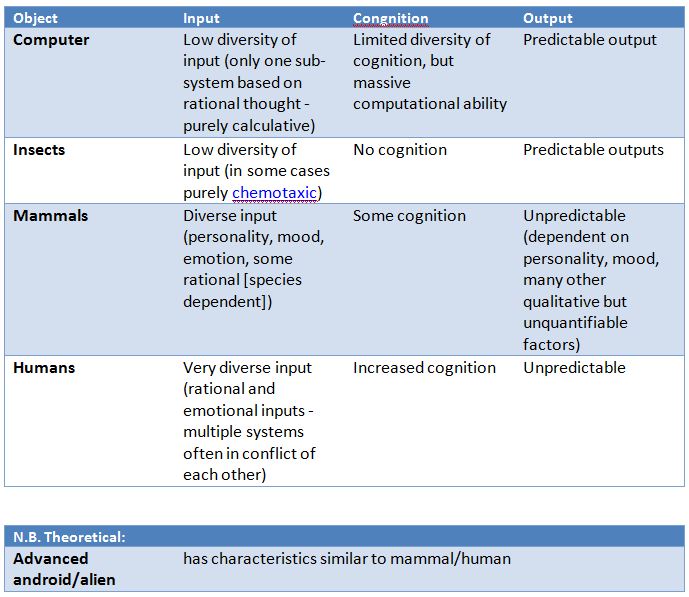
After killing the aforementioned mosquito, I sat on the toilet and thought hard about what does have value and why, eventually reaching the following conclusion. The difference between the bug, the computer, the mammal and us humans, is the complexity and diversity of our sensations, thought and responses.
In a sense, the computer and the insect are the same. They have no desires, no wishes. They are both machines based on very simple architectures. The computer has vast processing power, capable of sums no human can do, but it cannot choose to do anything. It simply responds to a stimulus and acts directly upon it. The relationship between stimulus and response is hard or softwired.
Humans and animals are slightly more complicated. Whilst, to a degree, we are also hard and softwired, we appear not to be. Much of this is due to the complexity of our 'hardware'. We actually have many distinct outcomes that, due to the limitation of our brains, we cannot quantify (however, perhaps there is a species somewhere in the universe that will look upon us in the same way we look at insects?).
Anyway, the point is that our complexity comes from our ability to receive data from wide ranges of 'sources' that are often in conflict. The insect does not think in the same way we do because it never has to choose between biting someone/thing or running away. This decision is made entirely based on direct stimuli.
Humans have to receive 'inputs' (I use this term for lack of a better word) in the form of desires, personality, emotions, sensations and thoughts. Decisions are made based on these (and probably many other) things. Even a cow has to choose whether to keep finding food, or lay down because it's tired or moody. These might not be choices in the same way that humans have to choose, but they're certainly far closer than a computer ever gets.
If computers eventually develop the same level of complexity in their thinking and develop their own needs, aspirations and sensations then I believe I would feel guilty for ending a computer's 'life'.
Hey, it might all be bollocks. I'm currently very tired (writing this at 2am) and I suspect this whole post is very poorly written. I'm also very aware of how debatable each aspect of the argument is, particularly because, to my knowledge, the language needed for much of this discussion doesn't currently exist in the mainstream (and more importantly, in my vocabulary). I'll probably read this back tomorrow and think it's all ridiculous. Either way, I can say I had a eureka moment on the toilet, so the whole experience was worthwhile.
ADDENDUM:
Here's a simplified, tabulated version of what I was trying to say before. Hope it makes some sense

Update: July 29th 2010
I reread this and here is my self-commentary:
Is this an attempt to rationalise the irrational? The guilt is an emotion triggered (supposedly) by my connection to other sentient beings. Why do I even give this life value above others? Most likely because I, as many humans do, define myself mostly by my sentience. "I think, therefore I am". My concept of identity and individuality is centered around consciousness. I have placed value in these things, therefore I project these values onto other sentient beings. I connect with them. I feel for them in a way I cannot for non-sentient beings that don't value these things.
It is somewhat simplistic to say that all action is selfishly motivated - mostly because it implies negativity - but it does serve as a reminder that the only way we can ultimately judge the consequences of our actions is by the emotion it makes us feel. I myself am guilty of forgetting this. To try to quantify the value of life by its resemblance to the 'human experience' is deeply flawed. In this attempt I was fairly oblivious to the ridiculousness of the endeavour.
That's not to say, however, that the system does not have its merits. In fact I still believe much of what I wrote. Much of the understanding will most likely be robust enough to serve its purpose as my personal guideline. Nevertheless I am aware that in all likelihood, millennia from now, this view will be looked back upon as inhumane.
Essentially what I'm trying to say is that morality in this form is an attempt to process and make sense of [thought] something that we cannot easily process [emotion]. In this case, I was not trying to find 'truth' exactly , but rather to process my guilt for killing the insect. Without the emotion, I would not feel the need to compare the value of life and my only way of judging whether I have been 'correct' in my comparison is the alleviation from that guilt.
In the end, morality is still irrational and no amount of thinking can change that. Of course, it is deeply important from a personal perspective as well as a sociological one. It's just something I feel it's important to be aware of...
First I placed myself in the 'shoes' of this mosquito, happily flying around, looking forward to its next meal - probably a nice quart of my fresh blood. Of course, this 'empathy' was deeply flawed. The mosquito cannot be 'happy' for it lacks the central nervous system needed to feel this emotion. Nor can it 'look forward' to anything.
If I remember correctly, woodlice move their legs dependent not on 'thought' or 'feeling' but simply because light speeds up the chemical reaction in their legs, making them move more quickly, therefore making them move away from light. A simple mechanism that I imagine makes them hidden from predators and move closer to a food source.
It might be fair to say that this woodlouse is not more complicated than a simple machine. In fact, we, as humans, have built far more complicated machines than this woodlouse. The mechanism I described wouldn't be out of place in a child's toy.
As always, technological advances force us to redefine our understanding of the world around us. We have created synthetic machines that are, in many respects, more advanced than basic lifeforms. Does that not mean that one day we will be able to create machines more advanced than us? What then is the makeup of the greatest mystery of human existence - what is consciousness?
I would not say the woodlouse is a conscious being and I would not say a child's toy is either. Knowing this, I would have no qualms about 'killing' either of these things arbitrarily. I would equally feel no guilt for destroying the most advanced computer in the world (other than for the cost of damages, of course). I would not feel like a life has been taken.
I would feel this guilt if, for instance, I killed a fellow mammal. A friend showed me this rather brutal video (which is possibly the most NSFW thing I've seen since 2girls1cup). It does feel bad seeing animals in distress.
This is of course due to the very noticeable and very 'human' expression of distress. However, if there were a completely new (possibly alien) species than we knew had equal 'consciousness' to a cow (or any mammal) but did not show their distress (perhaps they do not even feel any) I would still feel more guilty than I would do destroying a computer.
Why is this? Why do organisms have more value than synthetic beings, even though their ability to 'think' is very similar? In fact you could argue that everyday computers are far better at 'thinking' than we are. I'm fairly sure there are super computers that exist that have more overall processing power than the human brain (which by the way is remarkable for its size - evolution FTW). By comparison these machines are worthless in and of themselves. Their 'life', their 'thought' has no value.
After killing the aforementioned mosquito, I sat on the toilet and thought hard about what does have value and why, eventually reaching the following conclusion. The difference between the bug, the computer, the mammal and us humans, is the complexity and diversity of our sensations, thought and responses.
In a sense, the computer and the insect are the same. They have no desires, no wishes. They are both machines based on very simple architectures. The computer has vast processing power, capable of sums no human can do, but it cannot choose to do anything. It simply responds to a stimulus and acts directly upon it. The relationship between stimulus and response is hard or softwired.
Humans and animals are slightly more complicated. Whilst, to a degree, we are also hard and softwired, we appear not to be. Much of this is due to the complexity of our 'hardware'. We actually have many distinct outcomes that, due to the limitation of our brains, we cannot quantify (however, perhaps there is a species somewhere in the universe that will look upon us in the same way we look at insects?).
Anyway, the point is that our complexity comes from our ability to receive data from wide ranges of 'sources' that are often in conflict. The insect does not think in the same way we do because it never has to choose between biting someone/thing or running away. This decision is made entirely based on direct stimuli.
Humans have to receive 'inputs' (I use this term for lack of a better word) in the form of desires, personality, emotions, sensations and thoughts. Decisions are made based on these (and probably many other) things. Even a cow has to choose whether to keep finding food, or lay down because it's tired or moody. These might not be choices in the same way that humans have to choose, but they're certainly far closer than a computer ever gets.
If computers eventually develop the same level of complexity in their thinking and develop their own needs, aspirations and sensations then I believe I would feel guilty for ending a computer's 'life'.
Hey, it might all be bollocks. I'm currently very tired (writing this at 2am) and I suspect this whole post is very poorly written. I'm also very aware of how debatable each aspect of the argument is, particularly because, to my knowledge, the language needed for much of this discussion doesn't currently exist in the mainstream (and more importantly, in my vocabulary). I'll probably read this back tomorrow and think it's all ridiculous. Either way, I can say I had a eureka moment on the toilet, so the whole experience was worthwhile.
ADDENDUM:
Here's a simplified, tabulated version of what I was trying to say before. Hope it makes some sense
Update: July 29th 2010
I reread this and here is my self-commentary:
Is this an attempt to rationalise the irrational? The guilt is an emotion triggered (supposedly) by my connection to other sentient beings. Why do I even give this life value above others? Most likely because I, as many humans do, define myself mostly by my sentience. "I think, therefore I am". My concept of identity and individuality is centered around consciousness. I have placed value in these things, therefore I project these values onto other sentient beings. I connect with them. I feel for them in a way I cannot for non-sentient beings that don't value these things.
It is somewhat simplistic to say that all action is selfishly motivated - mostly because it implies negativity - but it does serve as a reminder that the only way we can ultimately judge the consequences of our actions is by the emotion it makes us feel. I myself am guilty of forgetting this. To try to quantify the value of life by its resemblance to the 'human experience' is deeply flawed. In this attempt I was fairly oblivious to the ridiculousness of the endeavour.
That's not to say, however, that the system does not have its merits. In fact I still believe much of what I wrote. Much of the understanding will most likely be robust enough to serve its purpose as my personal guideline. Nevertheless I am aware that in all likelihood, millennia from now, this view will be looked back upon as inhumane.
Essentially what I'm trying to say is that morality in this form is an attempt to process and make sense of [thought] something that we cannot easily process [emotion]. In this case, I was not trying to find 'truth' exactly , but rather to process my guilt for killing the insect. Without the emotion, I would not feel the need to compare the value of life and my only way of judging whether I have been 'correct' in my comparison is the alleviation from that guilt.
In the end, morality is still irrational and no amount of thinking can change that. Of course, it is deeply important from a personal perspective as well as a sociological one. It's just something I feel it's important to be aware of...
Friday, 18 June 2010
Prime Minister's Questions (16.06.10)
Well it seems I gave Cameron too much credit last time. I praised his ability to recognise successes from both parties. Methinks I spoke too soon.
This week he was brutal, responding to all of Harman's questions by attacking the former government. As I said in my last post, I hate this. Particularly when it's used as an evasive strategy to avoid questions on difficult subjects. The blame game is old politics, not 'new'.
There was some fierce debate on the unemployment figures (that was cleared up here). During this argument the Prime Minister was noticeably arrogant and bitter. Much more like the privileged public schoolboy act I abhor. I'm a keen believer in personality being a key factor in good leadership - Cameron hardly showed his best side.
It was sad to see Clegg nodding along. Much of what he symbolised was a different, more moderate, balanced approach to politics. During the election campaign, he mostly seemed to shy away from the political point-scoring. He was hardly squeaky-clean, but he did seem the best of the party leaders. It's strange to see him now supporting Cameron's shameless Labour-bashing. Admittedly I don't think I've ever seen a man look so uncomfortable doing it, but he is doing it.
As far as I'm concerned, Simon Hughes is the de facto leader of the Liberal Democrats and Clegg is just stuck as a pretty useless member of the cabinet. His role should be bringing Lib Dem policy to the forefront of the argument. Instead, he seems suffocated in a government he can never fully support. I can imagine him becoming increasingly frustrated with his position. Particularly as Cameron will spread his wings further and their differences will become far more apparent.
This week he was brutal, responding to all of Harman's questions by attacking the former government. As I said in my last post, I hate this. Particularly when it's used as an evasive strategy to avoid questions on difficult subjects. The blame game is old politics, not 'new'.
There was some fierce debate on the unemployment figures (that was cleared up here). During this argument the Prime Minister was noticeably arrogant and bitter. Much more like the privileged public schoolboy act I abhor. I'm a keen believer in personality being a key factor in good leadership - Cameron hardly showed his best side.
It was sad to see Clegg nodding along. Much of what he symbolised was a different, more moderate, balanced approach to politics. During the election campaign, he mostly seemed to shy away from the political point-scoring. He was hardly squeaky-clean, but he did seem the best of the party leaders. It's strange to see him now supporting Cameron's shameless Labour-bashing. Admittedly I don't think I've ever seen a man look so uncomfortable doing it, but he is doing it.
As far as I'm concerned, Simon Hughes is the de facto leader of the Liberal Democrats and Clegg is just stuck as a pretty useless member of the cabinet. His role should be bringing Lib Dem policy to the forefront of the argument. Instead, he seems suffocated in a government he can never fully support. I can imagine him becoming increasingly frustrated with his position. Particularly as Cameron will spread his wings further and their differences will become far more apparent.
Wednesday, 9 June 2010
Prime Minister's Questions: Cameron's Second. My First.
This was my first time seeing Cameron on PMQs. I've never been a huge fan, because I find myself frustrated seeing the argument never go anywhere. However, this time I was glued to the screen. There was real debate here.
First off, Cameron deserves credit for his performance. He was confident and convincing. His PR skills are certainly far better than Brown's ever were. This will be very important throughout his term as leader. With harsh cuts on the way he will need to utilise this skill to keep the British public on his side.
Whilst I certainly don't instinctively agree with the policy decisions of the Tory government, they are (at least mostly) in power. It's reassuring to see a leader that listens and responds even to his opposition.
Cameron certainly argued his case well, and at times I found myself agreeing with him. I'm not sure about CCTV or Iraq/Afghanistan, but he did make a clear case about gun laws and redrawing constituency boundaries.
Many commentators claim that Harman failed to land any real blows against Cameron's electoral policy, but I feel she made an incredibly good point about electoral registration. I doubt this will change the coalition's policy, but it does stick in my mind.
Conversely I can see Cameron's point about Labour not sorting this out in their time in Government. I don't think that's a good enough argument to ignore it now, but it's still a good point.
I still can't side with his views on the failures of the previous government, but it's nice to know that it's unlikely we have another Thatcher on our hands. Whatever my beliefs are, much of the country are quite angered by the last 13 years of Labour government. The situation could be much worse.
I have to admit that I'm still on the side of the coalition. I want this to work out because I think it's in the country's long term interest for governments to be open and break the long-standing tradition of partisan, two-party politics. I can't say the same for all of Tory policy, but I recognise that Cameron is a far more open and progressive Tory leader than any before him. In many ways I prefer his personality to Gordon Brown's, who I found could be unnecessarily stubborn on important changes in policy.
First off, Cameron deserves credit for his performance. He was confident and convincing. His PR skills are certainly far better than Brown's ever were. This will be very important throughout his term as leader. With harsh cuts on the way he will need to utilise this skill to keep the British public on his side.
Whilst I certainly don't instinctively agree with the policy decisions of the Tory government, they are (at least mostly) in power. It's reassuring to see a leader that listens and responds even to his opposition.
Cameron certainly argued his case well, and at times I found myself agreeing with him. I'm not sure about CCTV or Iraq/Afghanistan, but he did make a clear case about gun laws and redrawing constituency boundaries.
Many commentators claim that Harman failed to land any real blows against Cameron's electoral policy, but I feel she made an incredibly good point about electoral registration. I doubt this will change the coalition's policy, but it does stick in my mind.
Conversely I can see Cameron's point about Labour not sorting this out in their time in Government. I don't think that's a good enough argument to ignore it now, but it's still a good point.
I still can't side with his views on the failures of the previous government, but it's nice to know that it's unlikely we have another Thatcher on our hands. Whatever my beliefs are, much of the country are quite angered by the last 13 years of Labour government. The situation could be much worse.
I have to admit that I'm still on the side of the coalition. I want this to work out because I think it's in the country's long term interest for governments to be open and break the long-standing tradition of partisan, two-party politics. I can't say the same for all of Tory policy, but I recognise that Cameron is a far more open and progressive Tory leader than any before him. In many ways I prefer his personality to Gordon Brown's, who I found could be unnecessarily stubborn on important changes in policy.
V Pliot
I'm a sucker for sci-fi. When I heard about V I couldn't help but be at least a little interested. I don't know much about the original 1983 series, but I thought I might as well watch an episode of the reboot.
To get straight to the point, the pilot was really good. However, I'll admit now that it did have a rather big 'wow factor' that I'm not sure they'll be able to maintain for the rest of the series. The special effects were some of the best I've ever seen for a TV show. There's little chance the budget will allow for that kind of spectacle every week.
The characters introduced were interesting and mostly 'real' (ok, so they're sometimes cheesy, but they mostly get away with it). There's some (albeit limited) chemistry between the actors that's unspectacular, but watchable. Also, two words - Alan Tudyk.
As with much of good sci-fi, the genius truly lies in the subtext. There was a fair amount of exposition to help demonstrate what the show will attempt to explore. There was clear mention of indoctrination (and parallels drawn with religious extremism), parental responsibility (and teenage rebellion - itself paralleled with political rebellion) and political corruption. These themes will almost certainly play a big role in the show overall. So far they've been compelling and I hope the writers can keep it up.
Whilst I can't say I truly believe that the series will continue to be as good as this episode, I think the creators deserve credit for making an excellent pilot. The plot and characters are laid out clearly and the direction was used very effectively to help tell the story. The image on screen is often contrasted with the dialogue to highlight differences in characters' viewpoints and, conversely, to draw parallels between other characters. The dialogue itself is quite clever and often carries dual meanings. I get the feeling this has all been very well thought out.
In addition, the episode was well-paced and there were interesting, believable plot points that moved the story along. I didn't notice any examples of lazy writing or deus ex machina. This is often a dead giveaway of a poor sci-fi show. If the same attention to detail is given to the whole season then this show could really work. I hope it does.
To get straight to the point, the pilot was really good. However, I'll admit now that it did have a rather big 'wow factor' that I'm not sure they'll be able to maintain for the rest of the series. The special effects were some of the best I've ever seen for a TV show. There's little chance the budget will allow for that kind of spectacle every week.
The characters introduced were interesting and mostly 'real' (ok, so they're sometimes cheesy, but they mostly get away with it). There's some (albeit limited) chemistry between the actors that's unspectacular, but watchable. Also, two words - Alan Tudyk.
As with much of good sci-fi, the genius truly lies in the subtext. There was a fair amount of exposition to help demonstrate what the show will attempt to explore. There was clear mention of indoctrination (and parallels drawn with religious extremism), parental responsibility (and teenage rebellion - itself paralleled with political rebellion) and political corruption. These themes will almost certainly play a big role in the show overall. So far they've been compelling and I hope the writers can keep it up.
Whilst I can't say I truly believe that the series will continue to be as good as this episode, I think the creators deserve credit for making an excellent pilot. The plot and characters are laid out clearly and the direction was used very effectively to help tell the story. The image on screen is often contrasted with the dialogue to highlight differences in characters' viewpoints and, conversely, to draw parallels between other characters. The dialogue itself is quite clever and often carries dual meanings. I get the feeling this has all been very well thought out.
In addition, the episode was well-paced and there were interesting, believable plot points that moved the story along. I didn't notice any examples of lazy writing or deus ex machina. This is often a dead giveaway of a poor sci-fi show. If the same attention to detail is given to the whole season then this show could really work. I hope it does.
Tuesday, 8 June 2010
The Boondocks
The Boondocks follows two black kids from inner-city Chicago who've been sent to live with their rich uncle in the suburbs. The story itself is not hugely important, but it provides the set up for what this show does best - social satire and biting political commentary.
The whole show acts as window through which the writer expresses his viewpoint as a true disillusioned 'African American'. So rarely does it seem that any black TV writer gets the opportunity to express their views this way without having to conform to the rules of mainstream American society. Thankfully, Aaron McGruder (creator) uses this opportunity to its fullest. The show is controversial, in-your-face and often downright offensive. Never before have I heard the 'N-bomb' dropped so many times in a show.
This may seem like a terrible thing, but it's only offensive to the people that, quite frankly, deserve to be offended. The 'N-bomb' is only overused because it is overused in real life. Much like other great satire, it uses these shock tactics to help highlight the ridiculous elements that exist in African American culture and (more broadly) American politics.
The Boondocks is thoughtful, obscene and incredibly funny. Everything it should be.
The whole show acts as window through which the writer expresses his viewpoint as a true disillusioned 'African American'. So rarely does it seem that any black TV writer gets the opportunity to express their views this way without having to conform to the rules of mainstream American society. Thankfully, Aaron McGruder (creator) uses this opportunity to its fullest. The show is controversial, in-your-face and often downright offensive. Never before have I heard the 'N-bomb' dropped so many times in a show.
This may seem like a terrible thing, but it's only offensive to the people that, quite frankly, deserve to be offended. The 'N-bomb' is only overused because it is overused in real life. Much like other great satire, it uses these shock tactics to help highlight the ridiculous elements that exist in African American culture and (more broadly) American politics.
The Boondocks is thoughtful, obscene and incredibly funny. Everything it should be.
Open Source: The Way of the Future?
For those who aren't 1337 h4xx0r5, the GNU Public license is the most widely used freeware license. It's one of many licenses that allows the creation of Open Source projects. I'm sure many reading this have never even heard of open source, so I'll elaborate. 'Open source' means that the source code of any software is available on a project hosting site to be edited by a host of community programmers. Unlike most commercial software development, this software is created for free by a group of enthusiasts that hop in and out of development whenever they choose. No individual/group owns the intellectual property.
The GNU public license is the legal framework for this kind of development. It allows programmers to submit code to the project without fear that code will be stolen or copied by other individuals and used for profit. There are actually many ways of profiting, but there are significant restrictions on anything that might in any way compromise the overall project.
It seems that open source is becoming more and more common in our generation. Part of this is because we now have the technology that allows us to do this incredibly easily. High-speed broadband, large amounts of web-space for hosting, advances in general program development, etc. all allow 'sharing' to happen much more easily than ever before. In my view, open source will become even more popular in the future as more people realise its advantages.
My first experience with open source projects came from homebrew on the Wii. Homebrew programming has been around for a long while. Video game consoles are essentially custom-built gaming PCs and many gamers felt that they should be able to run their own programs on these systems just like they do on their computers. They've paid for the hardware and are using entirely original code to bend the system to their will.
Their are currently large communities of amateur Wii programmers developing their own code to run on the Wii. Applications range from simple programs to back up their save games to fully fledged media players capable of turning your Wii into a media centre PC.
ALL of these projects are open source and all completely free. If a project is popular then more users will be attracted to it, more programmers will submit code and more users will report bugs. This means that updates can regularly be added to the program, fixing bugs present in previous versions and also adding new features. I've seen several projects, starting from humble roots, eventually develop into incredibly deep and robust applications. In fact, now I use the homebrew applications more than the original Nintendo apps! They work better, have greater functionality and greater use. Many Wii users don't even realise these exist and purchase expensive hardware that don't do the job nearly as well.
There has been some debate as to the legality of these homebrew projects. Mainly by the big hardware manufacturers that dislike their systems being used for purposes other than they were initially intended. Nintendo has tried many times to take legal action against the creators of such software. In my view, homebrew is only as illegal as adding spoilers and rims to a car or upgrading a part in a computer. No copyrighted intellectual property is used and all the code is entirely original. If a user chooses to change their system, for whatever reason, the manufacturer should have no control over it.
This legal issue thankfully doesn't affect PC users. Open source projects have thrived for many years on this platform. Many users are unlikely to have even noticed that they are using these types of programs because they haven't researched their development. Even web novices use programs like Firefox or VLC player. I heard quite recently that for the first time ever, Firefox has become more frequently used than Internet Explorer.
For anyone that has ever used these browsers I'm sure they'll notice that Firefox is faster, more intuitive and just all around better, even though Microsoft employs a huge team of developers to work on their browser (who, by the way, are employed using the money you spent buying their Windows operating system). They still can't best a project that is available entirely for free.
With talk of Windows, it's worth mentioning that there are entirely free operating systems available too. For those that don't realise, every time a computer is purchased with Windows or Mac OS X pre-installed, a surcharge is added to cover the cost of operating system development. I recently built my own computer and since I already own a Windows 7 license key, I saved myself the £100+ surcharge that would be added if a bought a computer with an OS. Many don't realise they're paying this fee and assume that computers actually just cost that much. They don't. Parts are surprisingly cheap, it's software that is unnecessarily expensive.
Now I like Windows 7. In fact I love Windows 7. It's fast, simple and functional. It helps that I got the license on a student offer that only cost me £30. That's a bargain in my eyes. However, this very same license normally costs 4 times as much and there are actually better alternatives available for free.
Ubuntu is part of the Linux family of operating systems. It's available at no cost and for a long while it has been better than Windows and OS X. I used Windows XP for almost a decade because Vista was just an abomination. All these years, I used (and paid for) an OS that was inferior just because I had no idea that there was any alternative.
Ubuntu recently released version 10.04 and after a quick play around with it I know it's actually better than the Windows product I currently own. The only reasons it's not my main OS is that I've already paid for Windows 7. From now on, I'll almost certainly choose a Linux build over paying for an upgrade. I'd also probably advise anyone else to do the same. It takes a little getting used to, but it's designed with novice users in mind, so expect simplicity and streamlined functionality. All drivers are pre-installed, connecting to the internet is automated, programs and features can be un/installed with a click and, hell, it even integrates your social network sites directly into the OS.
Most people never learn this, of course, because Microsoft has deals with manufacturers to ensure that Windows is distributed on 90% of PCs before they even reach the consumer. A recent European Commission ruling judged that Microsoft was creating a monopoly of internet browsers by integrating Internet Explorer into Windows 7. By the same logic, I believe that Microsoft's control over manufacturers stifles competition in the OS market. Could we perhaps see an eventual ruling that prevents this happening? I can't imagine it will happen any time soon.
It does raise an important point though. Technology is developing at such a fast rate that it's difficult for legislation to catch up. In my experience, those currently in power greatly misunderstand technology and so conduct that is otherwise illegal in other forms of business are rarely noticed.
I'm currently in the process of buying a new phone. I have to admit that I'm rather excited about getting an Android phone. Android is an open source OS for mobile devices (i.e. mobile phones). With the increasing success of smart phones, it is becoming more clear that consumers are looking for devices with functionality similar to a PC. After all, like video games consoles, mobile phones are just specialised computers.
Applications (or 'apps') have become incredibly popular as flexible functionality becomes more important. Before, every single phone of the same model had the same features. We can now add apps that work within the phone's OS to add functionality that previously didn't exist. Apple has had incredible success with its iPhone but, in my view, it is still limited by the OS of the device itself. If a bug exists, the original OS developer is still needed to fix that bug. Android doesn't have this problem. In fact, because the source code is available online, anyone with sufficient skill can (in theory) legally create their own version of the OS and tweak it to their liking.
However, things aren't so hunky dory. Currently, your mobile service providers have the final say on what Android version can be installed on any smartphone. This is not the case for sim-free, factory unlocked versions, but it is true for any other phone. If your phone came with a sim card and has an Operator logo on the box, then you're out of luck. You'll have to wait for that version of the OS to be approved by your network. This can take months, even years. It's a pretty ridiculous system that allows the Service Providers to push their users into upgrading their phones more regularly by allowing bugs to persist. It's the equivalent of your computer manufacturer restricting your upgrade to the latest version of Windows, only to then turn around to you and say that they can sell you a new computer that does have the new software that you were entitled to get for free in the first place. There are no laws against this, so the system is easily exploited by those with know-how.
I've talked a lot about open source yielding better results - better software for the consumer - and that's all very well, but how do these people make any money? Community led projects are not owned by any individual and cannot be sold. What would happen if all software became open-source? Many of these 'enthusiasts' are actually programmers working for big software companies, who use their spare time to help support a project they really like.
At the moment, this is the big problem I see with Open Source. It's still reliant on large corporations to support the skilled individuals who then contribute to these projects. I can complain all I want about Microsoft and mobile phone service providers exploiting the system for profit, but if the law did change, wouldn't these companies make less money? Wouldn't there be less jobs for programmers working for Microsoft, Apple or Orange? Consequently, wouldn't there be less skilled people to actually work on these projects?
It's a valid argument. The restrictions on this technology allows more profit to be made, which is then reinvested into the software industry. If all software was open source, there would need to be a way for people to make money off it, without compromising or restricting the project. There needs to be a reason for people to be sufficiently interested in programming to make it their career, without worrying about financial difficulties.
Now I've quite clearly delved into the realm of economics. There's no way for this model to work without skilled programmers in large numbers. By its very nature, open source maximises the number and variety of individuals working on any project and therefore means that end products tend to be better than proprietary software. This success is dependant on the number and skill of the programmers involved. Affecting these two factors positively is important for the prosperity of this model.
Therefore job attractiveness is important. Money and job satisfaction are probably the two most important factors in making this job appealing. I can imagine that much of the reason open source is already so successful is that it's far more satisfying working in a community, producing a product that people love (even more than the ones that they have to pay for). However It's less straight-forward to make money from freeware.
As with any popular, in-demand product there is always a way. XBMC is a good example. XBMC (XBox Media Center) is an open source media player originally developed as homebrew for the XBox but then brought over to multiple platforms including Linux, Windows and Mac OS X. The program is similar to Windows Media Center (WMC) and allows users to browse through their media collections using a TV. Once again the free version is almost unequivocally better than the Windows version. Boxee is a program that was developed from the XBMC source code and took the program in a slightly different direction. The developers have used the basic elements of XBMC, but added proprietary (closed source) elements that are all their own original intellectual property.
Boxee itself is free, but the developers managed to negotiate a deal with hardware developer, D-Link (most well-known for their network adapters and routers). D-Link have designed a hardware kit (named the Boxee Box) that bears the Boxee logo and acts as a specialised platform for this software. Boxee are paid by D-Link for the closed source elements that they own, D-Link get money from selling their hardware and the consumer gets a great, cost-effective product. Boxee's revenue is still heavily dependent on XBMC so they have vested interest in contributing heavily to the original project. They also have to release Boxee for free on all other platforms because the license prevents them making profit from the XBMC elements. Everybody wins.
Whilst things may not work out so well in every case, it does show that hardware development is a great source of revenue for open source developers. HTC have been able to do exactly the same thing by slightly modifying the Android OS and selling hardware with their version shipped on it. No other hardware manufacturer can use that exact software because HTC own the bits they've modified, but the whole Android project benefits from HTC's success and development. So long as HTC is able to continually create great software and hardware, they will always be able to make a profit. Is this not a true example of a meritocracy? Isn't this why we value the idea of a free market in the first place?
Of course, hardware is not the only route for revenue. There are many other projects that get money from advertising, donations and many other methods. If you're still not convinced that it's possible then here's an entire article on how profit can be made.
On top of that, due to the nature of a community led project, non-programmer users of the program are invited to participate in discussion and development. I myself have submitted bug reports and enhancement ideas for programs I like and want to support. Project hosting sites like Google Code make this simple and straight forward. There's a very democratic approach to the whole process. Each individual has a say in what the final product will be and can give their expertise (however limited) to the project. Great with ideas? Suggest a new feature. Great with computers? Write a few lines of code. Great with design? Help develop a new user interface.
The whole system rewards input, even in small amounts. Large companies producing commercial software would have to out-source for all these little things and the whole process ends up being incredibly cost-inefficient. The older model encourages developers to do the bare minimum to cut costs and just get a product out so it can sell. Quality control isn't such an integral part of the model as it is with Open Source. Here only the best ideas are retained and anything disliked will be changed in future releases.
I did want to end on a bit of a big bang, so I saved the best 'til last. Whilst it may not be software, it's still the biggest community-led project in the world. It's also the most widely used and widely revered. Yup, that's right, Wikipedia. If you haven't used this site then, chances are, you're completely brain-dead. This project has revolutionised the way we access information on the internet. It is the single greatest collection of information available in human history. If that doesn't convince you that Open Source is an integral part of our future, then I don't know what will.
For those who are interested, here are a few examples of excellent open-source projects that served as the inspiration for much of this article:
Firefox,
Google Chrome (Chromium project),
VLC Media Player,
Media Player Classic,
Linux,
Android OS (mobile),
Chrome OS,
Quake (Quakes I, II and III arena),
Doom,
Wolfenstein 3D,
GIMP [lol] (save yourself £500 and download this freeware Photoshop-equivalent),
XBMC (A vastly improved alternative to Windows Media Center)
Wiibrew (wiki for all legal Wii homebrew applications)
The GNU public license is the legal framework for this kind of development. It allows programmers to submit code to the project without fear that code will be stolen or copied by other individuals and used for profit. There are actually many ways of profiting, but there are significant restrictions on anything that might in any way compromise the overall project.
It seems that open source is becoming more and more common in our generation. Part of this is because we now have the technology that allows us to do this incredibly easily. High-speed broadband, large amounts of web-space for hosting, advances in general program development, etc. all allow 'sharing' to happen much more easily than ever before. In my view, open source will become even more popular in the future as more people realise its advantages.
My first experience with open source projects came from homebrew on the Wii. Homebrew programming has been around for a long while. Video game consoles are essentially custom-built gaming PCs and many gamers felt that they should be able to run their own programs on these systems just like they do on their computers. They've paid for the hardware and are using entirely original code to bend the system to their will.
Their are currently large communities of amateur Wii programmers developing their own code to run on the Wii. Applications range from simple programs to back up their save games to fully fledged media players capable of turning your Wii into a media centre PC.
ALL of these projects are open source and all completely free. If a project is popular then more users will be attracted to it, more programmers will submit code and more users will report bugs. This means that updates can regularly be added to the program, fixing bugs present in previous versions and also adding new features. I've seen several projects, starting from humble roots, eventually develop into incredibly deep and robust applications. In fact, now I use the homebrew applications more than the original Nintendo apps! They work better, have greater functionality and greater use. Many Wii users don't even realise these exist and purchase expensive hardware that don't do the job nearly as well.
There has been some debate as to the legality of these homebrew projects. Mainly by the big hardware manufacturers that dislike their systems being used for purposes other than they were initially intended. Nintendo has tried many times to take legal action against the creators of such software. In my view, homebrew is only as illegal as adding spoilers and rims to a car or upgrading a part in a computer. No copyrighted intellectual property is used and all the code is entirely original. If a user chooses to change their system, for whatever reason, the manufacturer should have no control over it.
This legal issue thankfully doesn't affect PC users. Open source projects have thrived for many years on this platform. Many users are unlikely to have even noticed that they are using these types of programs because they haven't researched their development. Even web novices use programs like Firefox or VLC player. I heard quite recently that for the first time ever, Firefox has become more frequently used than Internet Explorer.
For anyone that has ever used these browsers I'm sure they'll notice that Firefox is faster, more intuitive and just all around better, even though Microsoft employs a huge team of developers to work on their browser (who, by the way, are employed using the money you spent buying their Windows operating system). They still can't best a project that is available entirely for free.
With talk of Windows, it's worth mentioning that there are entirely free operating systems available too. For those that don't realise, every time a computer is purchased with Windows or Mac OS X pre-installed, a surcharge is added to cover the cost of operating system development. I recently built my own computer and since I already own a Windows 7 license key, I saved myself the £100+ surcharge that would be added if a bought a computer with an OS. Many don't realise they're paying this fee and assume that computers actually just cost that much. They don't. Parts are surprisingly cheap, it's software that is unnecessarily expensive.
Now I like Windows 7. In fact I love Windows 7. It's fast, simple and functional. It helps that I got the license on a student offer that only cost me £30. That's a bargain in my eyes. However, this very same license normally costs 4 times as much and there are actually better alternatives available for free.
Ubuntu is part of the Linux family of operating systems. It's available at no cost and for a long while it has been better than Windows and OS X. I used Windows XP for almost a decade because Vista was just an abomination. All these years, I used (and paid for) an OS that was inferior just because I had no idea that there was any alternative.
Ubuntu recently released version 10.04 and after a quick play around with it I know it's actually better than the Windows product I currently own. The only reasons it's not my main OS is that I've already paid for Windows 7. From now on, I'll almost certainly choose a Linux build over paying for an upgrade. I'd also probably advise anyone else to do the same. It takes a little getting used to, but it's designed with novice users in mind, so expect simplicity and streamlined functionality. All drivers are pre-installed, connecting to the internet is automated, programs and features can be un/installed with a click and, hell, it even integrates your social network sites directly into the OS.
Most people never learn this, of course, because Microsoft has deals with manufacturers to ensure that Windows is distributed on 90% of PCs before they even reach the consumer. A recent European Commission ruling judged that Microsoft was creating a monopoly of internet browsers by integrating Internet Explorer into Windows 7. By the same logic, I believe that Microsoft's control over manufacturers stifles competition in the OS market. Could we perhaps see an eventual ruling that prevents this happening? I can't imagine it will happen any time soon.
It does raise an important point though. Technology is developing at such a fast rate that it's difficult for legislation to catch up. In my experience, those currently in power greatly misunderstand technology and so conduct that is otherwise illegal in other forms of business are rarely noticed.
I'm currently in the process of buying a new phone. I have to admit that I'm rather excited about getting an Android phone. Android is an open source OS for mobile devices (i.e. mobile phones). With the increasing success of smart phones, it is becoming more clear that consumers are looking for devices with functionality similar to a PC. After all, like video games consoles, mobile phones are just specialised computers.
Applications (or 'apps') have become incredibly popular as flexible functionality becomes more important. Before, every single phone of the same model had the same features. We can now add apps that work within the phone's OS to add functionality that previously didn't exist. Apple has had incredible success with its iPhone but, in my view, it is still limited by the OS of the device itself. If a bug exists, the original OS developer is still needed to fix that bug. Android doesn't have this problem. In fact, because the source code is available online, anyone with sufficient skill can (in theory) legally create their own version of the OS and tweak it to their liking.
However, things aren't so hunky dory. Currently, your mobile service providers have the final say on what Android version can be installed on any smartphone. This is not the case for sim-free, factory unlocked versions, but it is true for any other phone. If your phone came with a sim card and has an Operator logo on the box, then you're out of luck. You'll have to wait for that version of the OS to be approved by your network. This can take months, even years. It's a pretty ridiculous system that allows the Service Providers to push their users into upgrading their phones more regularly by allowing bugs to persist. It's the equivalent of your computer manufacturer restricting your upgrade to the latest version of Windows, only to then turn around to you and say that they can sell you a new computer that does have the new software that you were entitled to get for free in the first place. There are no laws against this, so the system is easily exploited by those with know-how.
I've talked a lot about open source yielding better results - better software for the consumer - and that's all very well, but how do these people make any money? Community led projects are not owned by any individual and cannot be sold. What would happen if all software became open-source? Many of these 'enthusiasts' are actually programmers working for big software companies, who use their spare time to help support a project they really like.
At the moment, this is the big problem I see with Open Source. It's still reliant on large corporations to support the skilled individuals who then contribute to these projects. I can complain all I want about Microsoft and mobile phone service providers exploiting the system for profit, but if the law did change, wouldn't these companies make less money? Wouldn't there be less jobs for programmers working for Microsoft, Apple or Orange? Consequently, wouldn't there be less skilled people to actually work on these projects?
It's a valid argument. The restrictions on this technology allows more profit to be made, which is then reinvested into the software industry. If all software was open source, there would need to be a way for people to make money off it, without compromising or restricting the project. There needs to be a reason for people to be sufficiently interested in programming to make it their career, without worrying about financial difficulties.
Now I've quite clearly delved into the realm of economics. There's no way for this model to work without skilled programmers in large numbers. By its very nature, open source maximises the number and variety of individuals working on any project and therefore means that end products tend to be better than proprietary software. This success is dependant on the number and skill of the programmers involved. Affecting these two factors positively is important for the prosperity of this model.
Therefore job attractiveness is important. Money and job satisfaction are probably the two most important factors in making this job appealing. I can imagine that much of the reason open source is already so successful is that it's far more satisfying working in a community, producing a product that people love (even more than the ones that they have to pay for). However It's less straight-forward to make money from freeware.
As with any popular, in-demand product there is always a way. XBMC is a good example. XBMC (XBox Media Center) is an open source media player originally developed as homebrew for the XBox but then brought over to multiple platforms including Linux, Windows and Mac OS X. The program is similar to Windows Media Center (WMC) and allows users to browse through their media collections using a TV. Once again the free version is almost unequivocally better than the Windows version. Boxee is a program that was developed from the XBMC source code and took the program in a slightly different direction. The developers have used the basic elements of XBMC, but added proprietary (closed source) elements that are all their own original intellectual property.
Boxee itself is free, but the developers managed to negotiate a deal with hardware developer, D-Link (most well-known for their network adapters and routers). D-Link have designed a hardware kit (named the Boxee Box) that bears the Boxee logo and acts as a specialised platform for this software. Boxee are paid by D-Link for the closed source elements that they own, D-Link get money from selling their hardware and the consumer gets a great, cost-effective product. Boxee's revenue is still heavily dependent on XBMC so they have vested interest in contributing heavily to the original project. They also have to release Boxee for free on all other platforms because the license prevents them making profit from the XBMC elements. Everybody wins.
Whilst things may not work out so well in every case, it does show that hardware development is a great source of revenue for open source developers. HTC have been able to do exactly the same thing by slightly modifying the Android OS and selling hardware with their version shipped on it. No other hardware manufacturer can use that exact software because HTC own the bits they've modified, but the whole Android project benefits from HTC's success and development. So long as HTC is able to continually create great software and hardware, they will always be able to make a profit. Is this not a true example of a meritocracy? Isn't this why we value the idea of a free market in the first place?
Of course, hardware is not the only route for revenue. There are many other projects that get money from advertising, donations and many other methods. If you're still not convinced that it's possible then here's an entire article on how profit can be made.
On top of that, due to the nature of a community led project, non-programmer users of the program are invited to participate in discussion and development. I myself have submitted bug reports and enhancement ideas for programs I like and want to support. Project hosting sites like Google Code make this simple and straight forward. There's a very democratic approach to the whole process. Each individual has a say in what the final product will be and can give their expertise (however limited) to the project. Great with ideas? Suggest a new feature. Great with computers? Write a few lines of code. Great with design? Help develop a new user interface.
The whole system rewards input, even in small amounts. Large companies producing commercial software would have to out-source for all these little things and the whole process ends up being incredibly cost-inefficient. The older model encourages developers to do the bare minimum to cut costs and just get a product out so it can sell. Quality control isn't such an integral part of the model as it is with Open Source. Here only the best ideas are retained and anything disliked will be changed in future releases.
I did want to end on a bit of a big bang, so I saved the best 'til last. Whilst it may not be software, it's still the biggest community-led project in the world. It's also the most widely used and widely revered. Yup, that's right, Wikipedia. If you haven't used this site then, chances are, you're completely brain-dead. This project has revolutionised the way we access information on the internet. It is the single greatest collection of information available in human history. If that doesn't convince you that Open Source is an integral part of our future, then I don't know what will.
For those who are interested, here are a few examples of excellent open-source projects that served as the inspiration for much of this article:
Firefox,
Google Chrome (Chromium project),
VLC Media Player,
Media Player Classic,
Linux,
Android OS (mobile),
Chrome OS,
Quake (Quakes I, II and III arena),
Doom,
Wolfenstein 3D,
GIMP [lol] (save yourself £500 and download this freeware Photoshop-equivalent),
XBMC (A vastly improved alternative to Windows Media Center)
Wiibrew (wiki for all legal Wii homebrew applications)
Tuesday, 1 June 2010
The Matrix: A Retrospective
It's no exaggeration to say that this film helps define our generation. When it came out it was revolutionary. I rewatched it and I still think it's revolutionary.
The philosophical element is possibly the reason The Matrix stands out so clearly from others around it. This film changed the way people think about the world. We take it for granted how easily this film is used to help people think about existential concepts. The phrase, "y'know, like in The Matrix?" is commonplace. Ordinary.
However, it's also easy to read this and think that's the only reason this film is so great. After rewatching it, I've found greater appreciation for its story-telling and, more importantly, its style.
The Matrix is incredibly referential. Some influences are far more obvious than others. Most notably Cyber-punk and Kung-fu films. It's interesting that the Wachowski brothers have chosen such vastly different styles to form the overall aesthetic.
These elements seem to be fairly self-contained within individual locations. This is especially clear in the training scene where Morpheus fights Neo. The dark, grey, harsh asthetic of the 'real world' is juxtaposed against the fluid, airy wire-fights of the 'training world'. Ancient Chinese Zen clashes with futuristic Western dystopia - Crouching Tiger versus Alien.
'The Matrix', the training programs and the 'real world' all feel completely different. Each is clearly distinguished by its cinematography, character movement and music. The green filters used during scenes in 'The Matrix' world are iconic, becoming almost synonymous with this film.
There are other notable cinematic references. Much of the gun-oriented sequences are reminiscient of old-fashioned Spaghetti Westerns, most obviously in the final show-down with Agent Smith. There's a lot of mirrored imagery here that is very Sergio Leone.
There are a LOT of religious references too, mainly Christian, although some Buddhism and general Eastern philosophy too. To name a few: Zion, Judas Iscariot (Cypher), The Nebuchadnezzar, (Holy) Trinity, Neo rising from the dead and 'Spoon Boy'. Much of this seems incidental, but it's clear that the brothers have an interest in (and significant knowledge of) Christianity.
The most overt literary influence is Alice in Wonderland, which plays such a large part in the story. Neo follows the white rabbit, Morpheus asks him if he want to find out "how far the rabbit-hole goes" and Neo takes a pill in order to alter reality.
There's a lot of influence from classical literature too. The use of oracles and prophecies borrows from everything from Macbeth to Oedipus. There's also philosophy mixed in too. These elements are used as devices to explore the nature of destiny and free will. Neo is clearly a strong voice for Libertarianism, whilst Morpheus and The Oracle offer a more Compatibilist viewpoint.
However, simply listing everything that The Matrix has stolen from does not give the film-making duo the credit they deserve. Much of the content is entirely original. Who can forget the feeling when they first saw bullet-time, or the lobby-scene or even the crazy one-armed fight with Agent Smith at the film's climax? This was ground-breaking stuff!
All of these styles are layered over each other to form a hybrid that works exceptionally well. The Wachowski Brothers took influence from many other works and fused it with their own innovation and creativity to create one of the greatest and most influential films of our generation.
The philosophical element is possibly the reason The Matrix stands out so clearly from others around it. This film changed the way people think about the world. We take it for granted how easily this film is used to help people think about existential concepts. The phrase, "y'know, like in The Matrix?" is commonplace. Ordinary.
However, it's also easy to read this and think that's the only reason this film is so great. After rewatching it, I've found greater appreciation for its story-telling and, more importantly, its style.
The Matrix is incredibly referential. Some influences are far more obvious than others. Most notably Cyber-punk and Kung-fu films. It's interesting that the Wachowski brothers have chosen such vastly different styles to form the overall aesthetic.
These elements seem to be fairly self-contained within individual locations. This is especially clear in the training scene where Morpheus fights Neo. The dark, grey, harsh asthetic of the 'real world' is juxtaposed against the fluid, airy wire-fights of the 'training world'. Ancient Chinese Zen clashes with futuristic Western dystopia - Crouching Tiger versus Alien.
'The Matrix', the training programs and the 'real world' all feel completely different. Each is clearly distinguished by its cinematography, character movement and music. The green filters used during scenes in 'The Matrix' world are iconic, becoming almost synonymous with this film.
There are other notable cinematic references. Much of the gun-oriented sequences are reminiscient of old-fashioned Spaghetti Westerns, most obviously in the final show-down with Agent Smith. There's a lot of mirrored imagery here that is very Sergio Leone.
There are a LOT of religious references too, mainly Christian, although some Buddhism and general Eastern philosophy too. To name a few: Zion, Judas Iscariot (Cypher), The Nebuchadnezzar, (Holy) Trinity, Neo rising from the dead and 'Spoon Boy'. Much of this seems incidental, but it's clear that the brothers have an interest in (and significant knowledge of) Christianity.
The most overt literary influence is Alice in Wonderland, which plays such a large part in the story. Neo follows the white rabbit, Morpheus asks him if he want to find out "how far the rabbit-hole goes" and Neo takes a pill in order to alter reality.
There's a lot of influence from classical literature too. The use of oracles and prophecies borrows from everything from Macbeth to Oedipus. There's also philosophy mixed in too. These elements are used as devices to explore the nature of destiny and free will. Neo is clearly a strong voice for Libertarianism, whilst Morpheus and The Oracle offer a more Compatibilist viewpoint.
However, simply listing everything that The Matrix has stolen from does not give the film-making duo the credit they deserve. Much of the content is entirely original. Who can forget the feeling when they first saw bullet-time, or the lobby-scene or even the crazy one-armed fight with Agent Smith at the film's climax? This was ground-breaking stuff!
All of these styles are layered over each other to form a hybrid that works exceptionally well. The Wachowski Brothers took influence from many other works and fused it with their own innovation and creativity to create one of the greatest and most influential films of our generation.
Subscribe to:
Posts (Atom)